Mattress construction and comparison
Obasan and Vispring: Two Approaches to Mattress Construction
A premium mattress is not a single material or a promise of universal comfort. It is a layered design, and the choices beneath the cover—what supports the body, how the surface responds, and how the components are assembled—shape the experience. Obasan and Vispring offer useful reference points for comparing different construction priorities, but the best choice depends on the particular model and the sleeper.
Published November 21, 2026
Mattress shopping often begins with a familiar question: Is it soft or firm? That question matters, but it arrives late in the investigation. First comes a more revealing one: What is the mattress made of, and how do its layers work together? Construction affects support, pressure relief, temperature feel, durability, maintenance, and even whether a mattress can be rotated or adjusted over time.
Obasan and Vispring are two names shoppers may encounter while exploring organic mattresses and premium mattress construction. They should not be treated as interchangeable examples of luxury. Their individual models can differ in materials, internal structure, available comfort choices, and care requirements. A useful comparison therefore does not declare a winner from the brand name alone. It establishes a method for reading specifications, testing comfort, and asking the questions that turn a label into a meaningful decision.
This overview focuses on those questions. It is not a claim that every mattress from either maker follows one fixed design, nor a substitute for current model-specific information. Product lines and specifications can change; confirm details with the manufacturer or retailer before buying.
Start with the mattress, not the reputation
Brand recognition can help shoppers create a shortlist, but it cannot tell them whether a particular mattress will suit their bodies, bedroom, or household. A maker may offer multiple constructions and comfort levels, while two mattresses with similar names can feel quite different. Compare the exact models under consideration, using the same checklist for each.
Begin with a construction breakdown. Look for the materials in the comfort layers, the central support system, the cover, and any border or edge reinforcement. Ask whether a description identifies the materials precisely or relies on broad terms such as “natural,” “premium,” or “breathable.” Those words may describe an intention, but they do not replace a component list.
Next, establish how the mattress is assembled. A mattress might use a single core, several layered materials, a spring system, or a combination of components. The arrangement can influence how pressure is distributed and how much the surface yields. The construction should be evaluated as a whole: a comfort layer cannot be assessed in isolation from the support beneath it.
- Materials: What is each layer made from, and how thick is it?
- Support: What provides the mattress’s deeper support, and how is it configured?
- Comfort options: Are different firmnesses, builds, or customizations available for the selected model?
- Dimensions: Does the mattress fit the bed frame, room, and intended sleepers?
- Care: Can it be rotated, flipped, spot-cleaned, or otherwise maintained?
- Policies: What are the trial, delivery, return, and warranty conditions?
When details are absent, ask. A precise answer can be more useful than a polished slogan.
Obasan: examine the material choices model by model
Shoppers interested in Obasan mattresses may be drawn to questions of organic materials, layered construction, and the ability to choose a feel that fits their needs. Those interests make a careful specification review especially important. “Organic mattress” is not a complete construction description. It is a starting point for examining which components are certified, what materials are used in each layer, and how the finished mattress is intended to perform.
For any Obasan model, check the listed composition rather than assuming that every layer shares the same certification or material profile. Look for clear information about the support core, comfort layers, cover, and any other elements that contribute to the finished product. If the manufacturer offers different firmness or configuration choices, ask how those choices change the construction and whether they affect care or warranty terms.
Layered designs can make material selection and comfort adjustment particularly relevant. A shopper who likes a supple surface but needs a stable feel beneath it may prioritize a different configuration from someone who prefers a more uniform, firm surface. Neither preference is a verdict on quality. The question is how the specific arrangement feels under the sleeper and whether that feel remains comfortable across a full night.
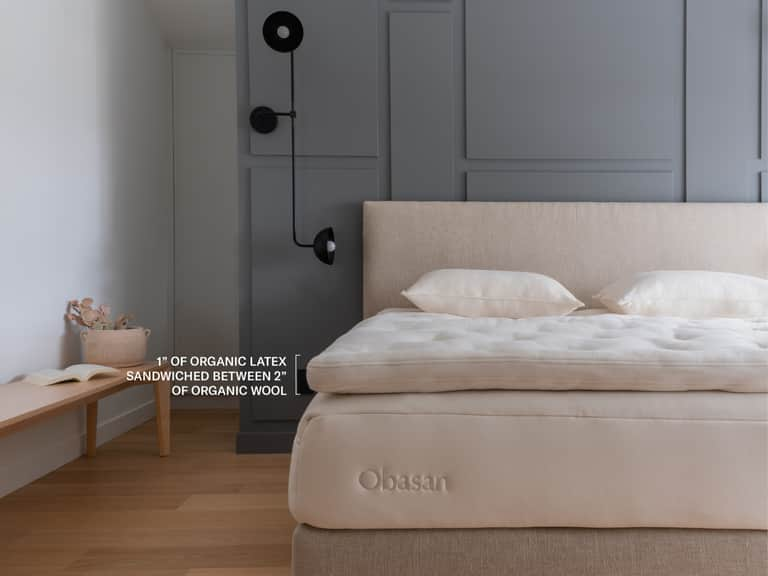
It is also worth distinguishing a mattress from a topper. A topper changes the feel of the existing sleep surface; it does not necessarily replace the mattress’s underlying support. For example, the Obasan Deluxe Organic Wool and Latex Mattress Topper is described as a 2.5-inch layer with organic latex surrounded by organic wool. Its product information describes a soft surface layer and advises against washing it, recommends careful spot cleaning, and says to protect it from getting wet. Those details illustrate why construction and care should be considered together. They do not, by themselves, establish the construction of any Obasan mattress.
For a mattress purchase, request model-specific specifications and a clear explanation of available options. If a retailer describes a model as customizable, establish exactly what can be selected, whether the choices are made at purchase, and what happens if the chosen feel is not right. “Custom” can mean different things in different product ranges; get the practical details in writing.
Vispring: look closely at the complete build
Vispring is another point of comparison in the premium mattress market. The brand name alone, however, does not tell a shopper the composition or feel of a particular model. As with Obasan, the useful unit of comparison is the individual mattress: its documented materials, support system, comfort options, dimensions, and care instructions.
When reviewing a Vispring mattress, seek a full description of the internal build. If a model includes a spring system, for example, ask how it is described by the manufacturer and what role it plays within the complete design. Then examine the comfort materials above it and the way the mattress is finished. The goal is not to rank one technical feature above all others. It is to understand how the components combine to create a surface that may feel different from a mattress built around another support approach.
Make sure comparisons are based on verified specifications, not assumptions about a brand’s entire range. A particular Vispring model may have options or construction details that are not shared by every model. Likewise, a broad description of a mattress category cannot substitute for the product sheet of the item being considered. Ask for current information, including which size and configuration the retailer is quoting.
Pay attention to how the mattress is intended to be supported. A bed frame, foundation, or base may affect stability, ventilation, and the manufacturer’s warranty requirements. Confirm compatibility before ordering, especially when replacing only the mattress or using an adjustable or slatted base. Avoid assuming that a setup suitable for one model is automatically suitable for another.
The comfort question: position, pressure, and personal preference
Construction matters because it shapes the way a mattress responds to a body. Yet no specification sheet can predict comfort perfectly. Sleep position, body shape, mobility, sensitivity to pressure, and personal preference all influence how a sleeper experiences a surface. Two people can lie on the same mattress and report different impressions without either being mistaken.
Side sleepers commonly pay close attention to pressure around the shoulders and hips. Back sleepers may focus on whether the surface feels supportive without creating uncomfortable pressure. Stomach sleepers often prefer a more stable feel, though individual needs vary. These are useful starting points, not medical rules or guarantees. The mattress should feel comfortable in the positions a person actually uses.
Firmness labels are not universal measurements. A “medium” from one maker may not feel like a “medium” from another, and the perceived firmness can change with the sleeper’s weight and the mattress base. If possible, test the precise model and configuration. Spend enough time in the usual sleeping position to notice pressure, alignment, and ease of movement. A brief sit at the edge or a quick press of the hand reveals little about a full night’s experience.
For couples, the comparison gains another dimension. Partners may differ in preferred firmness, sleep position, movement sensitivity, or temperature comfort. Ask whether the model offers configurations that address those differences and what the practical limitations are. A shared mattress is a shared decision, but it need not be made by averaging two preferences without discussion.
Temperature comfort also deserves a grounded assessment. Materials and construction can influence how warm or cool a bed feels, but room temperature, bedding, sleepwear, humidity, and individual physiology matter too. Terms such as “cooling” or “temperature regulating” should prompt questions about the actual materials and design, not be taken as a promise that every sleeper will remain cool.
Organic claims, certifications, and what to verify
For shoppers considering organic mattresses, certification language can help make material claims more legible. It is important to identify what a certification applies to: a fiber, a component, a finished product, or a particular stage of production. Do not assume that one certified material means every part of the mattress is certified in the same way.
Ask which materials are covered, whether the certification is current, and where supporting documentation can be found. If a product page uses terms such as “natural,” “eco-friendly,” or “chemical-free,” seek a more specific explanation. Broad claims may be meaningful in context, but clear descriptions of materials and standards are more useful for comparison.
Also consider the needs of the person who will use the mattress. Someone with a known material sensitivity may need to review components with a qualified clinician and obtain detailed information from the manufacturer. Certification can inform a decision, but it cannot guarantee that a product will be suitable for every individual or prevent all possible reactions.
Finally, separate environmental considerations from comfort conclusions. A material may appeal to a shopper for sourcing or certification reasons, while comfort still depends on the complete construction and how it feels in use. Both questions matter, but one does not answer the other.
Care and moisture: the part of construction shoppers overlook
A mattress is a long-term household purchase, and its care requirements should be understood before delivery. Read the exact instructions for the model rather than relying on general cleaning advice. Some products may permit rotation; others may have a designated top and bottom. Some components can be spot-cleaned cautiously, while others should not be washed or saturated. Follow the maker’s directions, especially where cleaning could affect a warranty.
Moisture management is relevant to any sleep environment. Perspiration, spills, and room humidity can affect bedding and, if not addressed, may leave a mattress damp. That does not mean a particular mattress is inherently vulnerable; it means prevention and prompt, appropriate care are sensible. Use bedding that fits securely, ventilate the room when practical, and deal with spills according to the product’s instructions. Never assume that a mattress can be dried with direct high heat or aggressive cleaning products.
A protector can add a washable barrier between the sleeper and mattress, but its fit and construction matter. The Sleep and Beyond Organic Cotton Waterproof Mattress Protector, for instance, is described as organic cotton jersey with a waterproof membrane and fitted sizing options for different mattress depths. Before choosing any protector, check the mattress depth, the protector’s care instructions, and whether the added layer changes the surface feel. A protector should be compatible with the bed, not merely labeled waterproof.
Care also includes the base. Confirm the required support and any ventilation recommendations. A mattress placed on an unsuitable foundation may not perform as intended, and failure to follow the maker’s support requirements can complicate warranty claims. Keep purchase records and care instructions somewhere accessible; years later, they can be more useful than memory.
A practical comparison checklist
Rather than trying to compress a complex purchase into a single score, make a side-by-side record of the facts. Use the same questions for the Obasan and Vispring models you are considering. If a retailer cannot answer one, mark it for follow-up instead of filling the gap with an assumption.
- Exact model and size: Record the full model name, dimensions, and configuration.
- Layer-by-layer materials: Note the material and thickness of each listed component.
- Support construction: Identify the central support system and ask how it is intended to work with the comfort layers.
- Comfort choices: Confirm firmness options, customization details, and whether the choice can be changed after delivery.
- Foundation requirements: Check base compatibility, spacing recommendations, and ventilation guidance.
- Care instructions: Clarify whether to rotate or flip, how to clean spills, and which products or methods to avoid.
- Protection: Check whether a protector is recommended and whether it may affect comfort or warranty coverage.
- Trial and returns: Read the time limits, fees, pickup arrangements, and condition requirements.
- Warranty: Understand what is covered, what counts as normal wear, and which setup requirements apply.
- Delivery: Confirm lead time, room-of-choice service, old-mattress removal, and access through stairs or hallways.
Write down the answers. The act of comparing them can reveal that the real decision is not “Which brand is better?” but “Which construction and ownership terms fit my needs?”
A disciplined way to make the decision
First, identify the non-negotiables: size, budget, material preferences, bed-frame compatibility, and any particular sensitivity or care constraint. Next, narrow the field to specific models with transparent specifications. Then compare comfort in person where possible, giving each mattress a fair test in the positions used at home.
After that, look beyond the showroom. A mattress may feel promising during a brief trial, but the purchase terms determine how much room there is to learn whether it suits you. Read the trial period carefully. Understand whether it begins at delivery, whether a minimum break-in period applies, and whether return or exchange fees are charged. Policies vary, and verbal summaries should not replace the written terms.
Do not let a high price stand in for evidence of a good match. Premium construction can involve materials or craftsmanship that matter to a particular shopper, but price alone does not establish comfort, longevity, or suitability. The right comparison balances the product’s documented construction with how it feels, how it fits the household, and how confidently it can be maintained.
In the end, Obasan and Vispring are best understood as starting points for investigation, not answers in themselves. The model-specific details carry the decision. Compare materials, support, comfort options, care, and policies; test the feel against your own needs; and verify any detail that could affect fit or long-term use.
Frequently asked questions
Are Obasan and Vispring mattresses built the same way?
No general brand comparison can establish that. Construction varies by model. Review the exact materials, support system, and configuration for each mattress rather than assuming that one description applies to an entire range.
Does an organic label tell me how firm a mattress will feel?
No. Organic claims concern material or production attributes, depending on the specific certification. Firmness and comfort depend on the complete design and the sleeper. Check both the certification details and the model’s comfort information.
Can a topper change the feel of an existing mattress?
A topper can add a layer of cushioning or alter the surface feel, but it does not necessarily correct inadequate support from the mattress beneath it. Confirm the topper’s dimensions, materials, and care requirements, and consider whether the underlying mattress remains comfortable and supportive.
What matters most when comparing premium mattresses?
Prioritize the exact construction, fit with your sleep preferences, comfort testing, support-base compatibility, care instructions, and written trial and warranty terms. A brand name can help organize your search, but those details should determine the comparison.